
Registration will happen at ground floor of SIMIS
26th June 11:00am to 5:00pm
27th June 8:00am - 9:15am
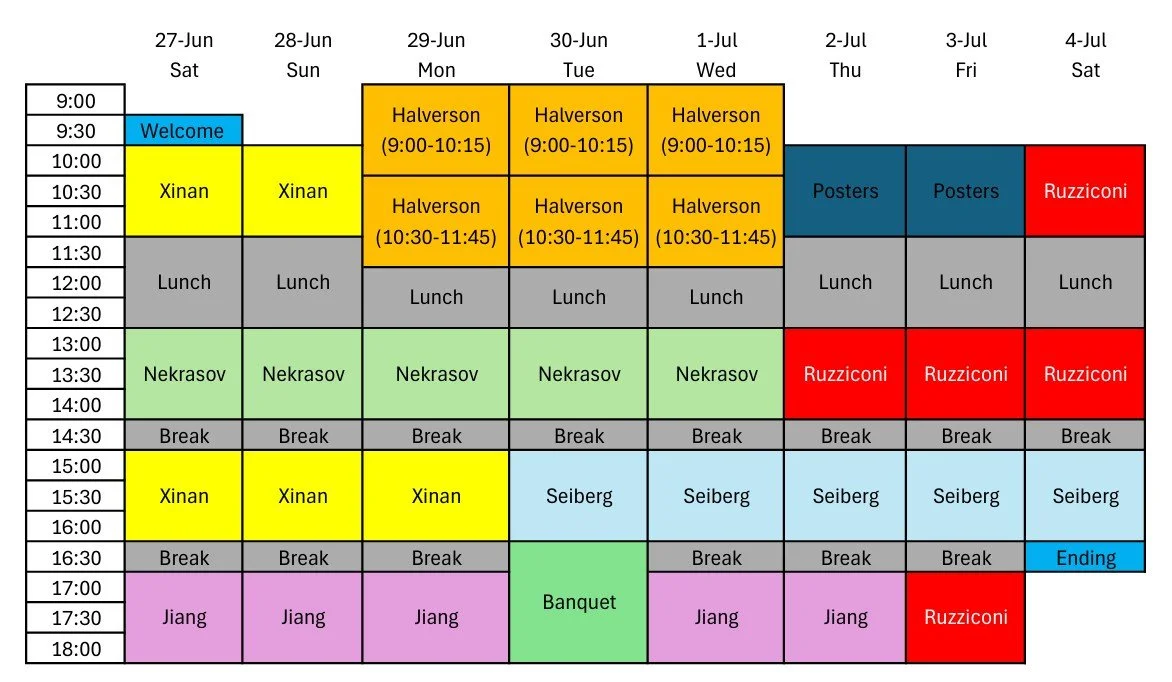
Jim Halverson
Pre-Strings Lectures on Artificial Intelligence and String Theory
These notes are based on six lectures given over three days at the Pre-Strings 2026 school in Shanghai. Day~1 develops neural network essentials, organized around the expressivity, statistics, and dynamics of neural networks, presented with a field-theoretic lens. Day~2 develops a neural network approach to field theory, in which a field theory is defined by a network architecture and a density on its parameters, and surveys recent results. Examples include a universality theorem, a neural network realization of Liouville theory, famous string amplitudes, topological sectors and the Kosterlitz-Thouless transition, Ward identities and anomalies, and a new derivation of the critical dimension of the bosonic string. Day~3 turns the lens around and covers applied AI for string theory: agentic workflows that are the of the other techniques are implemented, physics-informed neural networks and Calabi-Yau metrics, reinforcement learning and search in the landscape and in knot theory, and interpretable supervised learning with an eye towards conjecture generation.
Yunfeng Jiang
An Introduction to Integrability and Its Applications in the AdS/CFT Correspondence
In these lectures, I will discuss the basic ideas and techniques of integrability, as well as their applications in quantum field theory and string theory. The first three lectures will cover some core aspects of quantum integrability, including factorized scattering, Yang–Baxter integrability, and techniques in the thermodynamic limit. The last two lectures will focus more on applications in the AdS/CFT correspondence: one lecture will be dedicated to light single-trace operators, covering both their spectrum and OPE coefficients; the other will be dedicated to computing OPE data of heavy operators, such as giant gravitons.
Nikita Nekrasov
Supersymmetric Gauge Theories, Localization, and Gauge Origami
Supersymmetric gauge theories occupy a central place in modern mathematical physics, linking quantum field theory, string theory, algebraic geometry, representation theory, and integrable systems. This mini-course will introduce localization methods in supersymmetric gauge theories, with emphasis on instanton counting, moduli spaces, fixed-point formulas, and their combinatorial description via partitions.
A guiding theme will be the string-theoretic origin of these structures. We will discuss how four-dimensional supersymmetric gauge theories arise from geometric engineering in string theory, how their partition functions are related to curve counting on local Calabi–Yau threefolds, and how the correspondence between Gromov–Witten and Donaldson–Thomas theories fits naturally into this picture. We will also explain links between four-dimensional and six-dimensional gauge theories, including the role of compactification, defects, and higher-dimensional instanton moduli spaces.
The course will culminate in an introduction to gauge origami, a framework for organizing intersecting gauge-theoretic systems and their localization formulas. This perspective unifies instanton counting, defects, qq-characters, and higher-dimensional gauge-theory constructions.
Romain Ruzziconi
Carrollian physics and holography
I will review key developments in Carrollian physics with an emphasis on their role in the emerging framework of holography in asymptotically flat spacetimes. I will begin by introducing the Carrollian limit, understood as the contraction of the Poincaré group obtained by formally taking the speed of light to zero. The geometric structures associated with this limit will be described and argued to arise naturally on null hypersurfaces, most notably on null infinity, as well as on black hole and cosmological horizons. Building on this, we will examine the relation between the Bondi–Metzner–Sachs symmetries governing asymptotically flat gravity and the conformal Carrollian symmetries. Explicit examples of Carrollian field theories will be constructed by implementing the Carrollian limit on well-known relativistic field theories, with particular attention to Carrollian CFTs. I will then present the Carrollian holography proposal, according to which gravity in asymptotically flat spacetimes is dual to a Carrollian CFT living at null infinity in one lower dimension. In this framework, the massless S-matrix written in position space at null infinity will be naturally reinterpreted in terms of boundary Carrollian CFT correlators, called Carrollian amplitudes. I will highlight their relation to celestial amplitudes and show how they naturally emerge from holographic CFT correlators through a correspondence between the flat space limit in the bulk and the Carrollian limit at the boundary. Using this correspondence, I will provide strong evidence that flat space holography arises from a controlled and consistent limiting procedure applied to both sides of the AdS/CFT duality. I will conclude by outlining future directions and open questions in the program.
Reference: 2602.02644